How to Boost Your Website’s Visibility in the Age of AI-Driven Search — A 90-Day Playbook for Success
 Learning Management System by Prayug Editor | Jan 6, 2026


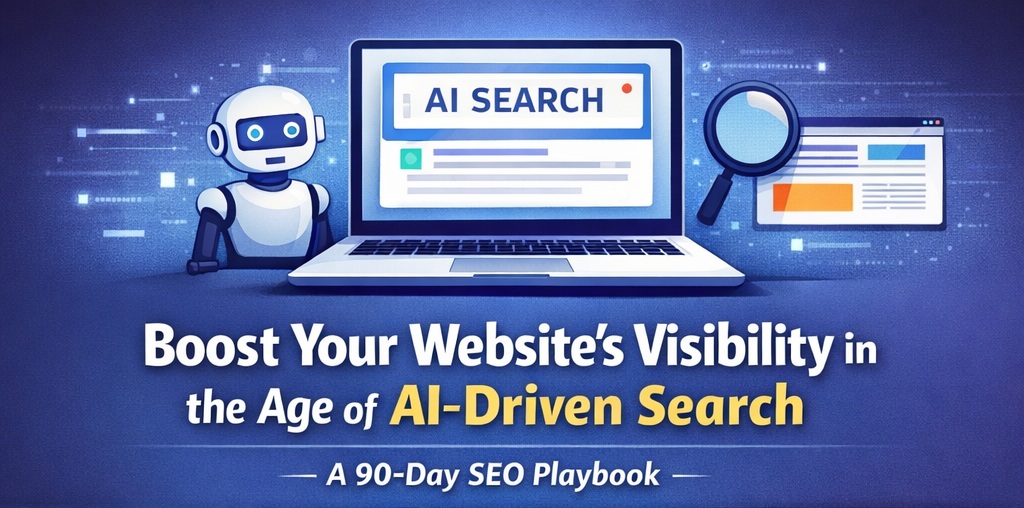
At Prayug, we understand that visibility isn’t just about more traffic — it’s about ensuring your audience sees your content where it matters most. So here’s a clear, practical 90-day SEO playbook you can follow to succeed in the era of AI-powered discovery.
Why Traditional SEO Isn’t Enough Anymore
AI-driven search results (like generative summaries, AI answer boxes, and conversational outputs) are becoming the default way users discover information. These systems often display answers without users ever clicking on your website. Studies show that in such environments, click-through rates can drop as low as ~8% when an AI summary appears.
That means you must focus not just on ranking — but on being selected, cited, and referenced by AI systems. That’s what this 90-day plan helps you do.
Phase 1: Build a Strong Foundation (Weeks 1–2)
1. Define Your Core AI Search Topics
AI doesn’t think in isolated keywords — it understands topics, entities, and user intent.
- Choose 5–10 topics your brand wants to be known for.
- For each topic, map out:
- Core questions users ask
- Comparison queries
- “How”, “Why”, and “Best” searches
👉 Example: If your brand focuses on digital marketing training, identify queries like:
- What is digital marketing training?
- How do digital marketing courses help build careers?
- Best online digital marketing certification programs
This helps AI understand what your content should answer.
2. Structure Your Content for AI Readability
AI systems extract and reuse content best when information is:
✔ Answer-first
✔ Clear and scannable
✔ Well-organized with bullets and FAQs
So, rather than burying key points deep in paragraphs, answer questions directly under relevant headers and format content to be easy for machines and humans to process.
Phase 2: Optimize for AI Answers (Weeks 3–6)
3. Focus on Generative Engine Optimization (GEO)
This means structuring pages so AI engines like ChatGPT, Gemini, or Perplexity can directly extract and cite your content:
- Use clear questions as headers:
“What is AI-driven search?”, “How does it work?” - Provide short, direct definitions before deeper explanations.
- Add a TL;DR summary after major sections.
This helps AI answer user queries with your content as the source.
4. Use Structured Data (Schema)
Structured data tells machines what your page is about — and why it should be trusted.
At a minimum, include:
- Article Schema
- Author Schema
- Organization Schema
Where appropriate, use FAQ Schema — but only when you genuinely provide Q&A content.
This helps generative systems identify content meaning and authority.
Phase 3: Build Authority & Trust (Weeks 7–10)
5. Strengthen E-E-A-T Signals
“E-E-A-T” stands for:
- Experience
- Expertise
- Authoritativeness
- Trustworthiness
AI systems increasingly favor content that shows real expertise and original insight.
✔ Add author bios with credentials
✔ Use real examples and case studies
✔ Include visuals, screenshots, and original data
This helps your content stand out as credible and informative.
6. Create Citation-Worthy Pages
Certain page formats are more likely to be referenced directly in AI responses:
- Ultimate guides on key topics
- Comparison tables (e.g., training courses vs self-study)
- Glossaries of common terms
- Statistical resources
These become trusted reference pages for AI summaries.
Phase 4: Multimodal SEO & Metrics (Weeks 11–12)
7. Optimize Beyond Text
AI systems today can see and interpret images and videos too:
✔ Add descriptive alt text to visual assets
✔ Include video content with transcripts
✔ Repurpose content into multimedia formats (YouTube, LinkedIn, etc.)
This broadens how AI can discover and use your content.
8. Track AI Visibility — Not Just Clicks
Traditional SEO focuses on rankings and traffic — but in the AI era, you should also monitor:
- Featured snippet ownership
- AI overview citations
- Brand mentions in AI tools
- Search impressions even without clicks
These give early signals of influence in AI search results.
Final Thoughts
Search isn’t just about keywords anymore — it’s about being understood, trusted, and cited by intelligent systems. With this 90-day playbook, Prayug helps you adapt to AI-driven search environments, build authority, and capture visibility where today’s users are actually discovering content. Join Prayug for Digital Marketing Course with AI.
Top Blog Posts