How to Build a Job-Ready Portfolio from Scratch
 Learning Management System by Prayug Editor | Jan 30, 2026


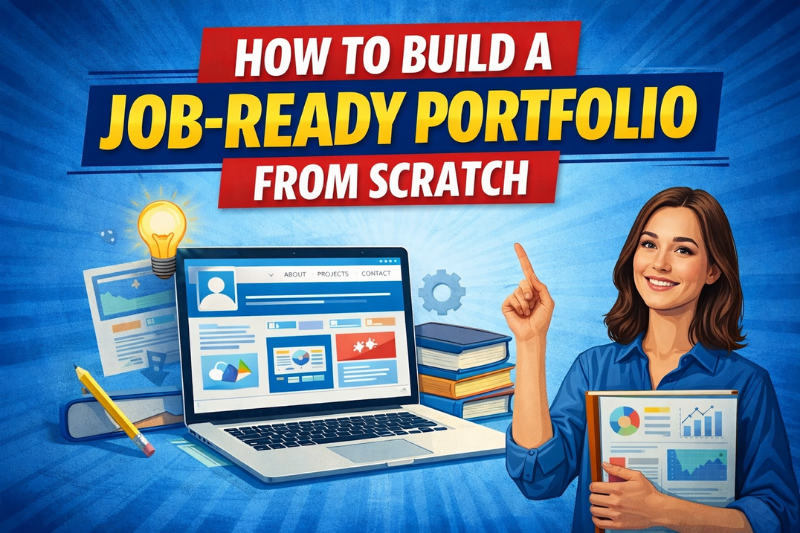
Clearing a very common misconception among students and freshers in India:
“I don’t have experience — what am I going to show in my portfolio?”
Here’s what the recruiters will not necessarily tell you straight out:
Everyone starts with zero experience.
The difference between confident candidates and nervous candidates is, after all not experience, but evidence.
And that evidence is your portfolio.
A good portfolio does not verify you have work in a company.
It shows that you are capable of doing the work.
First Reality Check: A Resume Lists Claims. A Portfolio Shows Proof
Resumes say:
- “I know Excel”
- “I’ve learned digital marketing”
- “I have coding knowledge”
Recruiters think:
“Show me.”
Which is why portfolios matter more than certificates — particularly for:
- Students
- Freshers
- Career switchers
- Self-taught learners
A portfolio helps turn learning into credibility.
What a Job-Ready Portfolio Actually Is (And Isn’t)
A job-ready portfolio is not:
- A folder of certificates
- Screenshots of course completion
- College assignments with no context
A job-ready portfolio is:
- A collection of practical projects
- Clear explanation of what you did
- Evidence of problem-solving
- Proof you understand real-world requirements
In short:
Your portfolio is the answer to the question that interviewer wasn’t asking:
“Can this person actually work?”
Step 1: Choose One Skill Direction (Do Not Mix Everything)
This is where the majority of students make their mistake.
They try to build:
- A data project
- A design project
- A marketing project
- A coding project
All at once.
Instead:
- Choose one primary skill
- Build depth, not noise
Examples:
- Analytics → dashboards and reports
- Online Marketing → Campaigns & Analytics
- Web development → functional apps
- Design → UX case studies
Focus creates clarity.
Step 2: Start with “Simulated Real-World” Projects
(Hint: You don’t need a job to create job-ready work.)
Start with:
- Dummy datasets
- Sample business problems
- Industry-style briefs
Examples:
- Retail store sales analysis
- Local brand social media campaign
- Small business website redesign
- Data dashboard for student performance
These are practice projects, and employers will take them — if they’re serious.
Step 3: Build Projects That Show Thinking, Not Just Output
Recruiters don’t just want results.
They want to see:
- How you approached the problem
- Why you chose certain methods
- What challenges you faced
- How you improved your work
Every project in your portfolio should answer:
“What was the problem and how did I solve it?”
This is maturity — not just prowess.
Step 4: Document Your Work Clearly
A strong portfolio project includes:
- Project objective
- Tools used
- Your role (even if solo)
- Key steps taken
- Final outcome
Indeed, this structure reminds interviewers how to walk through your thinking — and you as well.
Step 5: Quality Beats Quantity (Always)
Three solid projects beat:
- Ten half-finished ones
- Twenty copied examples
- Endless tutorials
Recruiters prefer:
- Fewer projects
- Deeper understanding
- Honest explanations
A good starter portfolio typically consists of:
- 3–6 well-documented projects
That’s enough to start interviews.
Step 6: Practice Explaining Your Portfolio (This Builds Confidence)
Half your job is the perfect portfolio.
The other half is:
- Explaining it clearly
- Answering follow-ups
- Defending your decisions
Practice:
- Talking through each project
- Discussing The Think you chose and why
- Discussing what you’d improve next
Here’s where confidence blossoms — organically.
Why Portfolios Matter More in the Indian Job Market
India has:
- High competition
- Similar degrees
- Limited interview time
Recruiters ain’t got time to figure it out.
Portfolios:
- Reduce hiring risk
- Show readiness
- Shorten decision cycles
Portfolios serve as an alternative to experience for freshers.
How Prayug Helps Learners Build Job-Ready Portfolios
At Prayug, portfolio building isn’t considered an option or left to the end.
It’s integrated into learning.
The approach focuses on:
- Live, guided project execution
- Industry-style problem statements
- Continuous mentor feedback
- Portfolio-ready outputs
- Interview-oriented explanations
The aim is simple:
Learners should exit with work they can legitimately show, not just courses they took.
Final Words: Portfolios Don’t Require Experience — They Create It
The wait-for-experience-before-you-build-a-portfolio path is backwards.
Portfolios are how you earn experience.
If you are a student or fresher:
- Start small
- Build seriously
- Explain clearly
For one simple reason: In interviews, proof trumps promise.
An job-ready portfolio is the best evidence you can offer.
Top Blog Posts