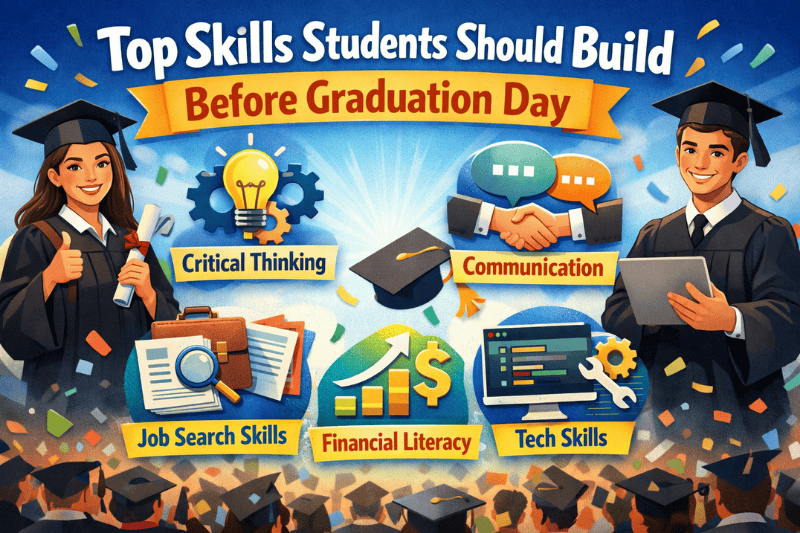
Top Skills Students Should Build Before Graduation Day
 Learning Management System by Prayug Editor | Mar 24, 2026


Graduation day is the finish line.
But for a majority of students in India, it’s just the beginning of a much tougher race.
You’ve attended classes.
You’ve passed exams.
You’ll soon hold a degree.
Then there is the question that no syllabus can prepare you for:
“Am I actually job-ready?”
Marks alone don’t provide the answer to that any more.”
Certificates don’t either.
What actually determines your placement success, interview confidence and the early growth in your career at work are SKILLS — practical, visible, usable skills.
Here’s a rundown of the most critical skills every student should already be laying the foundations for by graduation day — not after it.
Communication Skills (Not Just English Fluency)
Juniors at ELIC are all of the sudden afraid to communicate.
That’s just a piece of it.
Real workplace communication includes:
- Explaining your ideas clearly
- Asking the right questions
- Writing professional emails
- Presenting your work confidently
- Listening and responding logically
In interviews, it’s not vocabulary that companies are testing for.
They’re testing clarity of thought.
If you can explain:
What You Did What you did Your motivation for doing it And what, if anything, you learned from the experience
—you already stand out.
Start now:
- Practice explaining projects out loud
- Engage in dialogue, not only examinations
- Write summaries of your education
- Problem-Solving & Thinking Skills
Employers do not hire students to follow the same six steps.”
They hire them to think.
Problem-solving means:
- Dividing a complex problem into subproblems
- Some approaches that I'd suggest include: Picking an approach, rather than waiting to be told what to do
- Dealing with when there is no clear answer
This skill separates:
- Students who “know tools” from
- students who can work with tools intelligently
Start now:
- Work on open-ended assignments
- Seek “why” rather than “know how”
- Think about mistakes, don’t cover them up
- Practical, Job-Oriented Technical Skills
Degrees teach theory.
Jobs demand execution.
Whether you’re from:
- Engineering
- Science
- Commerce
- Arts
- Management
You need something hands-on that relates to your field.
This includes:
- Using real tools and software
- Working on industry-style projects
- Applying theory to practice and making sense of it
Hearing about something is different from doing it.
Start now:
- Build small projects
- Apply to real data sets or case studies
- Output is more important than just intake of the learning material
- Digital & Technology Awareness
You don’t have to be a coder in all these functions.
But you do require digital comfort.
Basic digital skills include:
- Using productivity tools effectively
- Understanding online collaboration
- Experience with data, dashboards or digital workflows
- Adapting quickly to new software
In the modern workplace, tech is not optional — it’s assumed.
Start now:
- Get a feel for the tools your industry does use
- Learn how companies really do digital stuff
- Quit being afraid of different platforms
- Time Management & Self-Discipline
College gives flexibility.
Jobs demand responsibility.
That so many students struggle after graduation because they were never taught;
- Meeting deadlines
- Prioritising tasks
- Managing energy, not just time
What employers look for is dependability, not raw talent.
Start now:
- Set weekly learning goals
- Finish what you start
- Track progress, not intentions
Consistency builds trust — fast.
Teamwork & Professional Behaviour
Real jobs are collaborative; no one works alone.
You’ll work with:
- Seniors
- Peers
- Managers
- Clients
Team skills include:
- Accepting feedback
- Handling disagreement professionally
- Taking responsibility
- Supporting others
They are almost never explicitly taught — but they are almost always being judged.
Start now:
- Work on group projects seriously
- Practice offering feedback and accept it in return
- Focus on solutions, not blame
- Adaptability & Learning Mindset
The biggest career risk today?
Thinking education is over after you graduate.
Industries change.
Tools evolve.
Roles transform.
Fastest-growin' students are those who:
- Learn continuously
- Unlearn outdated methods
- Stay curious instead of defensive
Start now:
- Learn like you’re never done
- Be open to change
- Focus on growth, not comfort
Why Building Skills Before Graduation Matters
If you wait until graduation:
- You panic during placements
- You rush into random courses
- You feel behind others
When you build skills early:
- Interviews feel natural
- Confidence improves
- Career choices become clearer
Degrees may qualify you.
Skills employ you.
Final Thoughts: Graduation Is Not the Goal — Capability Is
The day of graduation should be when you start planning.
It should be when you’re already ready.
Hand-on, students that invest in skills early on:
- Perform better in interviews
- Adjust faster in jobs
- Grow quicker in careers
Because it’s what you can do in the world, not what you studied, that matters more.
And skills — unlike marks — themselves accumulate for life.
Visit us for more info - Online Courses
Top Blog Posts