Cost & Management Accounting Course – Skills That Turn Numbers into Business Decisions
 Learning Management System by Prayug Editor | Feb 3, 2026


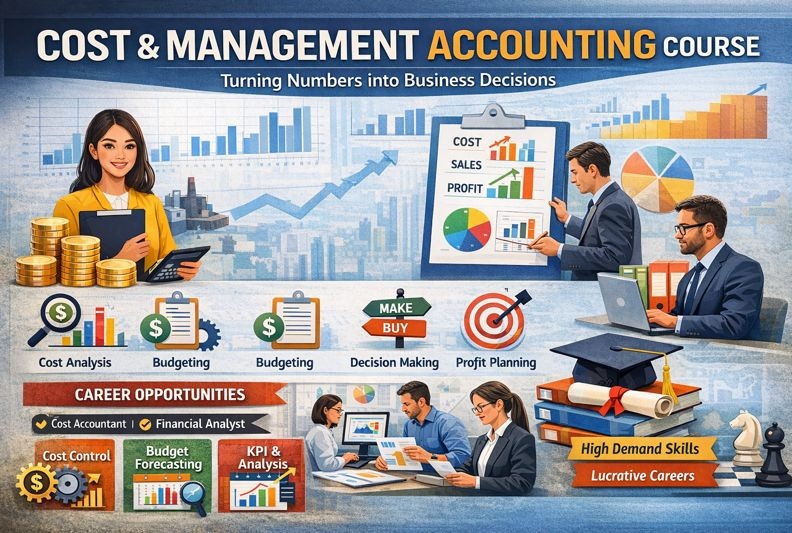
If you’re a commerce student, a graduate seeking a career boost or a professional aspiring to transition into finance and strategy roles, this course equips you with the essentials of how companies make, spend, save and invest money.
Let’s break it down in a simple and practical way.
What is Cost & Management Accounting?
Cost & Management Accounting is a specialized area of accounting that focuses on:
- Tracking business costs
- Controlling expenses
- Planning budgets
- Improving profit through smart decision-making
Unlike financial accounting (which is mainly for external reporting like tax and compliance), management accounting is used internally by managers to make business decisions.
In short:
👉Financial Accounting = What happened
👉Cost & Management Accounting = What should we do next
Why is a Cost & Management Accounting Course Important Today?
Every business — from small startups to big multinational companies — wants to:
✔ Reduce unnecessary expenses
✔ Increase profit margins
✔ Plan budgets properly
✔ Make data-driven decisions
This is where cost and management accountants play a key role. They help management answer questions like:
- Which product is most profitable?
- Where are we overspending?
- Can we reduce production cost?
- How much should we price our product?
- Is this project financially worth it?
Because of this, trained professionals in this field are in high demand across industries.
What You Learn in a Cost & Management Accounting Course
A well-designed CMA course covers both technical accounting knowledge and practical business decision skills.
1️⃣ Basics of Cost Accounting
You learn how to calculate and control different types of costs:
- Direct and indirect costs
- Fixed and variable costs
- Material, labor, and overhead costs
This helps in understanding how much it truly costs to produce a product or service.
2️⃣ Budgeting and Forecasting
Budgeting is the backbone of financial planning in any company.
In this module, you learn:
- How to prepare business budgets
- Sales and production forecasting
- Cash flow planning
- Budgetary control techniques
These skills help businesses avoid financial surprises and stay financially stable.
3️⃣ Cost Control Techniques
This part focuses on reducing waste and improving efficiency.
Topics often include:
- Standard costing
- Variance analysis
- Break-even analysis
- Marginal costing
You’ll be able to analyze why actual costs differ from expected costs and suggest improvements.
4️⃣ Management Decision Making
Here’s where accounting meets strategy.
You learn how to use numbers to support decisions like:
- Make or buy decisions
- Pricing strategies
- Product mix decisions
- Investment planning
This makes you not just an accountant — but a business advisor.
5️⃣ Performance Measurement
Companies need to know if departments and managers are performing well.
You’ll study:
- Key Performance Indicators (KPIs)
- Responsibility accounting
- Ratio analysis
- Financial performance evaluation
These tools help businesses track growth and improve results.
Who Should Do a Cost & Management Accounting Course?
This course is ideal for:
- Commerce Students (B.Com, M.Com)
- BBA / MBA (Finance) students
- Working professionals in accounts or finance
- Entrepreneurs and business owners
- Students preparing for CMA, CA, or ACCA-related careers
Even if you are not from a pure commerce background, many courses start from basics and gradually build advanced knowledge.
Career Opportunities After This Course
One of the biggest advantages of learning Cost & Management Accounting course is the wide range of career options.
Popular Job Roles
- Cost Accountant
- Management Accountant
- Financial Analyst
- Budget Analyst
- Business Analyst
- Internal Auditor
- Finance Executive
These roles exist in:
- Manufacturing companies
- Corporates and MNCs
- Banks and financial institutions
- Retail and e-commerce firms
- IT and service companies
Salary Prospects in Cost & Management Accounting
Though salary varies with qualification, skill and experience, following is an approximate idea:
• Freshers: Finance/Accounts - F0rm Entry-level
• Mid-level professionals: Analysts and management accounting position
• Experienced Individuals: Senior finance managers, cost controllers, consultants
As you get more experienced, you stop dealing just with numbers, you start impacting on business strategy, which makes you more valuable, and ultimately, pays you more.
Skills You Develop in This Course
This course doesn’t just teach accounting — it builds business thinking.
You develop:
✔ Analytical and logical thinking
✔ Cost control mindset
✔ Budget planning skills
✔ Decision-making ability
✔ Attention to detail
✔ Financial problem-solving skills
These are skills that are useful not only in jobs but also if you plan to start your own business.
Difference Between Cost Accounting and Management Accounting
Many students get confused between the two. Here’s a simple difference:
| Cost Accounting | Management Accounting |
| Focuses on calculating costs | Focuses on using financial data for decisions |
| Mainly historical data | Future planning and strategy |
| Cost control | Business planning and performance improvement |
Both are connected, and most courses teach them together.
How This Course Helps in Real Business Situations
Let’s say a company is making two products — Product A and Product B.
After cost analysis, you discover:
- Product A gives more profit
- Product B has high production cost and low margin
A management accountant may suggest:
👉 Increase production of Product A
👉 Reduce cost or stop Product B
This kind of decision can significantly improve a company’s profit. That’s the real power of cost and management accounting job oriented course.
Course Duration and Learning Mode
Depending on the institute, the course may be:
- Short-term certification (3–6 months)
- Diploma-level course
- Part of professional courses like CMA, CA, or MBA
Many institutes now offer:
- Online live classes
- Recorded lectures
- Practical case studies
- Real business examples
Practical learning is very important in this field.
Final Thoughts
A Cost & Management Accounting subject is not only concerned with numbers but with the way that companies operate financially and make intelligent decisions.
If you want a career where you:
✔ Work closely with business strategy
✔ Help companies grow profitably
✔ Build strong financial expertise
Then this course can be a powerful step toward a stable and rewarding career in account & finance management course.
Frequently Asked Questions (FAQs)
1. Is Cost & Management Accounting difficult?
It can be challenging at first, especially if you are new to accounting. But with regular practice and practical examples, it becomes easier and very interesting.
2. What is the difference between CMA and a regular accounting course?
A CMA-focused course emphasizes cost control, budgeting, and decision-making, while regular accounting courses focus more on bookkeeping and financial reporting.
3. Can non-commerce students do this course?
Yes, many beginner-level courses start from the basics. However, basic math and logical skills are important.
4. Is this course useful for MBA students?
Absolutely. It strengthens financial understanding, which is very useful in MBA specializations like Finance, Operations, and Business Strategy.
5. What software skills are useful along with this course?
Knowledge of Excel, accounting software, and basic financial analysis tools adds strong value to your profile.
6. What are the career growth opportunities?
With experience, you can move into senior roles like Finance Manager, Cost Controller, Business Analyst, or even CFO-level positions in the long term.
Top Blog Posts