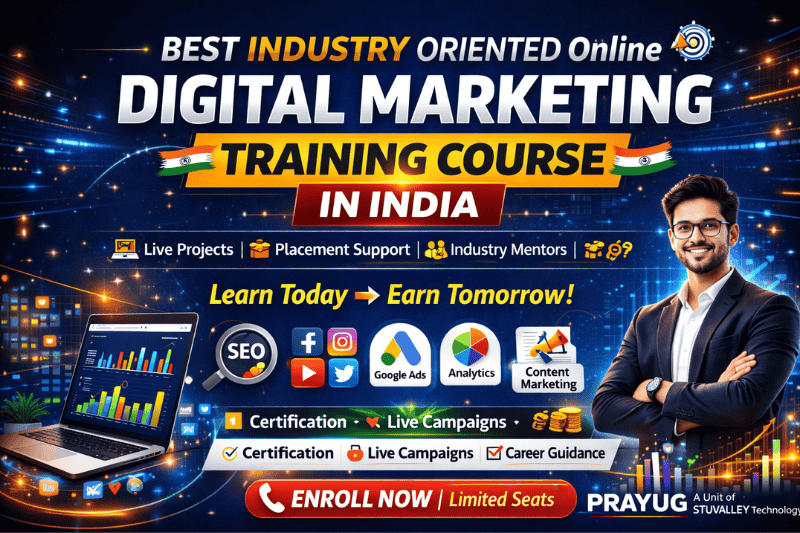
Best Industry Oriented Online Digital Marketing Training Course in India PRAYUG A Unit of STUVALLEY Technology
 Learning Management System by Prayug Editor | Feb 19, 2026


Introduction
Inside competitive digital channels where every activity is measured, modern marketing operates. Instead of relying on trial-and-error marketing, companies now depend on structured plans, data monitoring, and constant optimization. Employers thus favor those who have an understanding of marketing within actual firms rather than those who only have a theoretical grasp of definitions.
Engineered to mirror professional work settings, PRAYUG offers industry-focused digital marketing instruction. Students study the same campaign planning, execution, monitoring, reporting, and improvement processes used by businesses and agencies.
Emphasis in industrial-oriented training is on getting people ready to carry out precisely their obligations as specified in a job description. Before beginning their jobs, this approach lets students become accustomed to professional instruments, deadlines, and expectations.
Importance of Industry-Oriented Instruction
Training geared toward the business helps students to interact with actual business activities.
Rather of theoretical learning, pupils:
• Go over company objectives.
• Develop campaign plans.
• Regulate advertising expenses.
• Evaluation of performance
• Report gifts
This promotes pragmatic understanding and so speeds up workplace adjustment time.
Core Processes in Industry Cover
Assessment of Business Demand
Every marketing plan begins with objectives.
Important Areas of Learning
• Strategy for lead generation
• Brand recognition programs
• Goals for product sales
• Customer retention strategy
Students develop the ability to select business-appropriate channels.
Design and Planning for Campaign Strategies
Before implementation, participants create structured plans.
Technological Planning Phases
• Audience segmentation
• Platform choices
• Estimate budgets
• Timescale scheduling
• Choosing of performance indicator
This fits professional procedures.
Campaign Deployment
Students lead campaigns on real media.
Act of Execution
• Arrangement of advertisement groups
• Keyword charting
• Creative progression
• Landing page matching
• Track integration
Results are based on precision of execution.
Monitoring and Improvement
Performance monitoring is ongoing in actual organizations.
Methods of Optimization Employed
• Cost management changes
• Audiences' refinement
• Creative trials
• Conversion enhancement
Students see how performance alters following every adjustment.
Customer Contact and Reporting
Marketers have to present findings straightly.
Training in communication covers:
• Weekly performance summaries
• Strategic justification
• Planning of suggestions
• Return on Investment (ROI) explained
Tools for Business Covered
Participants work together with widely used organizational instruments:
• Dashboards for managing campaigns
• Analytics systems
• Keyword research programs
• Systems for managing tags
• Panels for social media
• Tools for automated emails
Direct use helps to create operational assurance.
Growing Technical Knowledge
Marketing Research Data Analysis
Through numerical patterns, one may learn user behavior.
Performance Improvement
Better outcomes attained by way of calibrated adjustments.
Strategy Development
Developing well-planned and expandable campaigns.
Development of Strategies
Picking channels consistent with corporate goals.
Expert Reporting
Successfully conveying ideas to the decision-makers.
How This Training Helps Employment
Businesses favor applicants needing little on-boarding.
By means of industry-oriented education:
• Improving knowledge of processes
• Developing real confidence
• Enhancing interview performance
• Showcase of responsibility
Actual Business Project Exposure
Learners tackle cases akin to those found in business settings:
• Encouragement of local services
• E-commerce promotional efforts
• Brand knowledge initiatives
• Leading generation funnels
Projects result in quantifiable results.
Professional Paths Following Industry-Focused Training
Graduates could work in positions including:
• Digital Marketing Aide
• Campaign Supervisor
• Performance Analyst
• SEO Strategist
• Growth Leader
Common Corporate Issues Addressed
Training gets pupils ready to face actual problems:
• Low conversion rates
• High marketing expenses
• Inadequate engagement
• Decline in traffic
• Tracking mistakes
Students learn organized problem-solving abilities.
Constant Skill Development Plan
Because marketing channels change frequently, professionals have to:
• Monitor update
• Examination techniques
• Change tactics
Training shapes adaptability patterns.
Frequent Concerns
1. What kind of education is based on business?
Education geared with real business operations.
2. Real campaigns are run by students?
Yes, practical application is covered.
3. Reporting is taught?
Performance presentation is certainly a top priority.
4. Are novices welcome?
Yes, we start with basics.
5. Will job interviews profit from this?
Actual experience improves technical reactions.
6. Does analysis count?
Yes, training in data analysis is available.
7. Does it encourage freelancers?
Yes, independent project management depends on skills.
8. How are skills judged?
By means of tasks of execution and analysis.
9. Might entrepreneurs gain?
Yes, it raises awareness of business promotion.
10. Is certification offered?
Indeed, performance assessment results in certification.
In Conclusion
Students get ready to boldly step into actual professional settings via industry-oriented digital marketing training. Individuals become able to contribute right away upon hiring by honing their abilities in business analysis, campaign implementation, optimization, and reporting. Actual exposure helps marketing long-term career stability and speeds up the learning curve.
Call to Action
Call / WhatsApp: +91 9599109192 / +91 96438 02216
Visit: www.prayug.com
Choose PRAYUG – the best Job oriented Training services in India and progress confidently toward Skill Development and better Career.
Top Blog Posts